
A Talent For Damage
Age Gap Erotic Short Story - S&M Awakening, FemDom

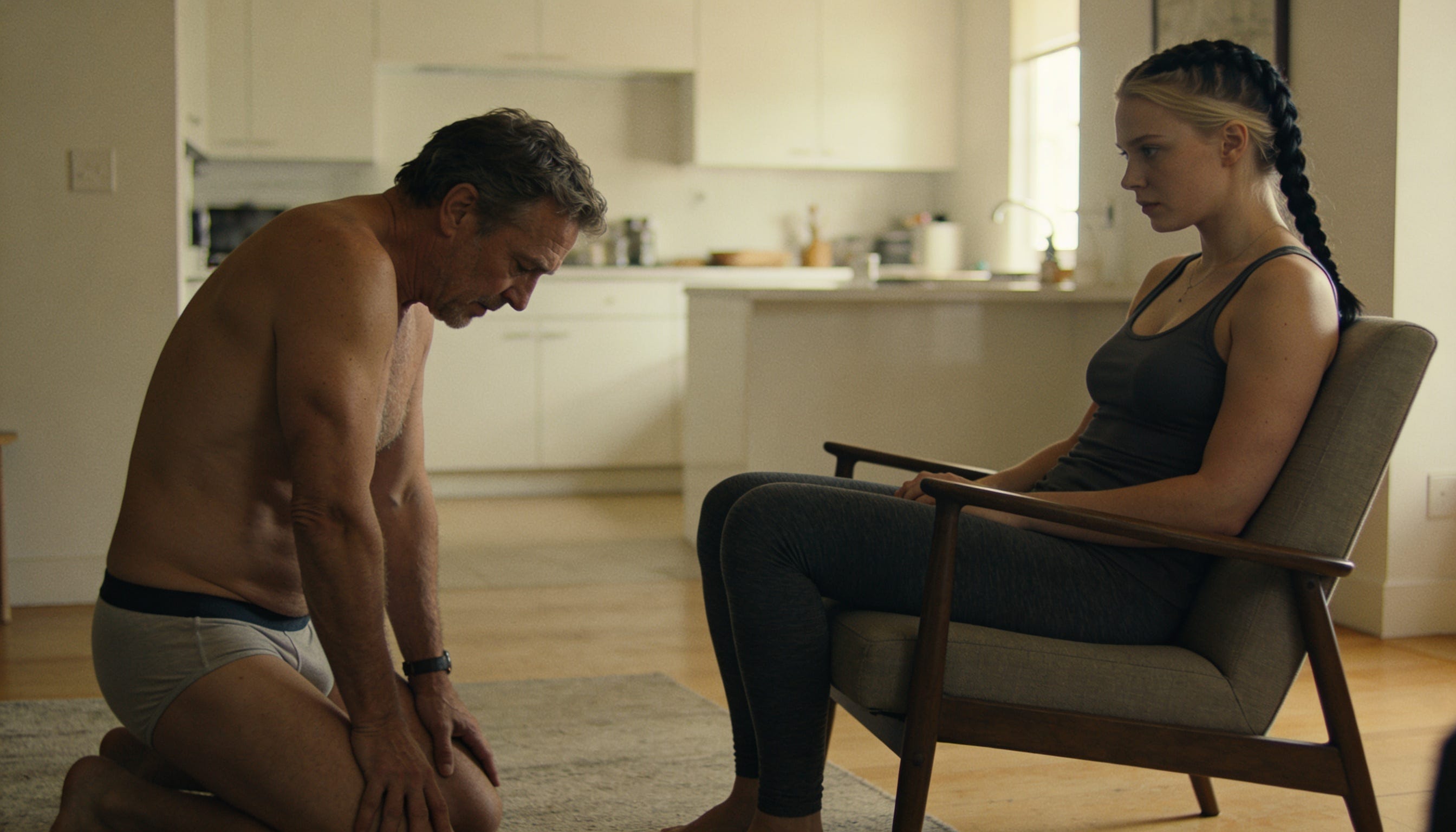
I have a talent for other people’s damage. Twenty-three years at Covenant Mutual, most of them in the Hartford office, and I can tell within four minutes of reading a claim whether the person filing it is in real pain or performing.
The body has a grammar. Real injury reports are messy, specific, contradictory. The woman in Meriden who described her back pain as “like someone parked a Buick on my spine but only on Tuesdays” was telling the truth. The man in Glastonbury who wrote “persistent, debilitating agony in the lumbar region” had googled that sentence the night before.
You learn to read it. The flinch. The inconsistency. The detail that doesn’t serve the story.
I am very good at spotting fraud.
Which is how I know what to call what I’ve been doing to my expense reports for the past six years.
Fraud.
Small fraud. The kind nobody audits because the numbers aren’t worth the paperwork. A $14 lunch claimed at $22. Mileage rounded up by eight or nine miles per trip. A conference in Stamford where I submitted for two hotel nights but drove home the second evening because the minibar was sad and I missed my condo. It amounted to maybe nine hundred dollars a year. Enough to be theft. Not enough, I told myself, to become anybody’s problem.
I didn’t need the money. I made $87,000 and my expenses were low since the divorce. The condo in West Hartford was paid off. I didn’t travel. I didn’t date.
I did it because nobody checked.
That was the reason I had given myself for six years, and it held up fine until Nora Mercer sat across from my desk on a Monday in October with a manila folder and a face I couldn’t read and dismantled it in three sentences.
•
She was twenty-two. I know because her intern badge had her start date and the analytics program recruited out of college. She had a math degree from UConn and dark hair she wore in a braid and the kind of posture that made you aware of your own. She’d been in the office a week, assigned to review expense documentation across all three floors as part of some modernization initiative that upper management was excited about and the rest of us were ignoring.
She was the only intern. She carried a laptop bag too big for her and wore clothes that were professional in the way of someone who had recently purchased them for this specific purpose.
Monday afternoon. She knocked. I said come in. She sat down across from me, opened the folder, and said, “Mr. Ellis, I have a few questions about your expense filings from the last two quarters.”
She went through them. Receipt by receipt. The lunch at Vito’s on June 12th, claimed at $22, actual total on the company card statement $13.80. The mileage log for the Bridgeport site visit, 47 miles claimed, 38.6 miles by Google Maps. The Stamford conference. She had the hotel folio from the corporate travel portal. One night posted. Two nights claimed.
I watched her lay it out. Her hands were small and her nails were short and she turned the pages of my fraud with a librarian’s efficiency. She didn’t look up at me while she talked. She didn’t need to. She was reading the evidence the way I read claims: looking for the pattern, the thing that didn’t add up.
When she finished, she closed the folder and looked at me for the first time.
“Would you like to walk me through the discrepancies?” she said.
I gave her the excuses. Rounding errors. A misremembered date. Possibly the wrong receipt attached to the Bridgeport filing. I delivered them the way I’ve heard a thousand claimants deliver their stories, with the easy confidence of a man who has decided what the truth is and is now helping you arrive at the same conclusion.
I was good at it. I’ve been listening to people lie for twenty-three years. I know how it’s done.
She let me finish. She didn’t interrupt, didn’t nod, didn’t give me the small conversational signals that tell a speaker he’s being believed. When I was done, she picked up the folder and stood.
“I’m not going to flag these,” she said.
No warmth in it. The way you’d tell someone the lab results came back negative. Here is a fact. Do with it what you will.
She walked out and closed the door behind her.
I sat at my desk for a long time after that. My mouth was dry. I was waiting for the relief to come, the rush of having gotten away with it, and instead what I felt was a low electrical hum in my chest. My hands were shaking. I was hard.
I was hard sitting at my desk at 2:15 on a Monday afternoon because an intern had just read me my own lies in a quiet voice and then decided, without explanation, to let me keep them.
I spent the rest of the week waiting. She reviewed my files for four more days. I could see her through the glass partition, at the temporary desk they’d set up for her near the copy room, working through the department’s records with a focus that made the rest of the office look like it was moving underwater. She didn’t come back to my office. She didn’t mention the discrepancies again. She passed me in the hallway on Wednesday and said “Good morning, Mr. Ellis” with the same flat professionalism she used with everyone, and I said “Good morning” and went into the men’s room and stood at the sink and looked at my face in the mirror.
The not-mentioning was worse than the mentioning had been.
She knew what I was. She had the folder. She could end me with a phone call to compliance. And she was choosing, every day, not to. The choosing was the thing. She had a lever and she was aware of having it and she was leaving it where it sat.
I couldn’t stop thinking about that. Her awareness. The calm of it. She had found a number that didn’t belong in the column, and she had left it there.
•
The second week. Tuesday. She came back.
She had questions about the claims I’d processed, which was different from the expense issue. Legitimate audit questions, the kind the analytics program was designed to generate. She wanted to understand my approval criteria. How I evaluated supporting documentation. What made me approve a claim versus flag it for further review.
She sat in the same chair and asked the questions with the same measured precision and I answered them and the whole time I was aware that we were both performing a scene that had a different scene running underneath it. The audit was real. It was also a cover. She was sitting in my office asking me to explain how I judged other people’s credibility, and we both knew she had already judged mine.
She asked me about a specific case. A woman in Meriden, chronic lower back pain, out of work for fourteen months. The documentation was solid. The woman’s GP, an orthopedist, an MRI. I’d approved the claim.
“Did you believe her?” Nora said.
“The documentation supported the claim.”
“That’s not what I asked. Did you believe she was in pain?”
“Yes.”
“How did you know?”
“She described it like a person in pain. She said it felt like someone parked a Buick on her spine but only on Tuesdays. People who are lying don’t give you the Tuesday. They give you textbook language because they’ve rehearsed it.”
Nora looked at me with an expression I would spend the next several days examining. She was interested. The interest had a quality I couldn’t locate on the usual spectrum of professional engagement. It ran warmer than that, and in a direction I didn’t expect.
“You’re good at knowing when people are lying,” she said. “And your own expense reports are full of lies you didn’t even try to make convincing. The Stamford conference. You claimed two nights and checked out after one. Anyone with access to the travel portal could verify that in thirty seconds.”
I didn’t say anything. There was nothing to say. She was correct and we both knew it.
“So either you’re lazy,” she said, “or you wanted to get caught. And you don’t seem lazy, Mr. Ellis.”
She picked up her laptop bag. She left.
I sat in my office with the door closed and my erection pressed against my slacks and thought about the Buick-on-Tuesdays woman. I had approved her claim because she told the truth badly, in the specific, graceless way of a person who is actually in pain.
Nora Mercer had found the weak place in my story and pressed her thumb into it.
•
At forty-eight, I looked like the kind of man people trusted with forms. Six-one. Thin in the way of men who forget to eat lunch, not in the way of men who exercise. Gray at the temples, brown everywhere else. A face that women in my age bracket described, when they were being generous, as “kind.”
I had been married for eighteen years to a woman named Sandra who left me for a real estate agent in Avon. The divorce was civil. We divided everything evenly, which meant I got the savings and she got everything I would have wanted if I’d been the kind of person who wanted things.
The condo I bought afterward had white walls and furniture I’d ordered online in a single evening, a couch and a bed and a kitchen table, the way you’d furnish a safehouse. My daughter, Allie, was in her first year at Northeastern. We talked on the phone every other Sunday. She was nineteen. I did the arithmetic once with Nora’s age and hated myself for it, then did it again the next day because shame has never stopped a man from checking his work.
I was fine. I had been fine for four years in the way that a house with no pictures on the walls is fine: structurally sound, ready for occupancy, empty.
I am saying this because when I tell you that Nora Mercer disassembled me, I want you to understand what she was taking apart.
•
I asked her to get a drink. This was the third week. She was finishing her audit rotation in our department and would be based in Farmington after Monday, though she’d still be in Hartford twice that week to close out files. I framed it as a thank-you, for not flagging the discrepancies. I framed it badly. She knew it was badly framed and said yes anyway.
We went to a bar on Pratt Street that was too nice for a Tuesday evening. I ordered a bourbon. She ordered a gin and tonic and drank half of it before she said anything that wasn’t about work.
The conversation started with the audit and moved through the company and arrived, after the second round, at personal terrain. She asked about my divorce. I told her. She asked about my condo. I described it and she said, “That sounds bleak,” and I said, “It’s efficient,” and she smiled at that, a small, private smile that I would think about later while lying in bed.
She told me she was from Wallingford. She’d done the math degree because she was good at it and taken the insurance internship because it paid and because she wanted to understand how systems worked. She didn’t care about insurance. She cared about patterns, about the place where human behavior became legible as data.
She said it like data had never betrayed her.
We were still on the second drink when she said it.
“You liked it. When I went through your files. You were scared but you liked it.”
I held my glass. The ice shifted.
“I don’t know what you mean.”
She waited. She was good at waiting. It was, I was learning, her primary instrument. She created a silence and let you fill it, and whatever you filled it with told her what she needed to know.
“I noticed how you were sitting,” she said. “In your office. Both times. You were nervous, which makes sense. But you were also hard. Which doesn’t.”
The bar was dim and half-empty and she said the word hard the way she said everything, with the clinical precision of a woman presenting findings.
“Nora.”
“I’m not embarrassing you. I’m telling you what I saw. You got hard while I read your lies back to you. I want to know why.”
“I don’t know why.”
“I think you do.”
I put my glass down.
“This is a very strange conversation to be having with someone who could report me to compliance.”
“I’m not going to report you to compliance. I told you that three weeks ago. I’m asking you a question.”
“Why do you want to know?”
She turned her glass on the coaster. One rotation. Two. She was deciding something.
“Because I liked it too,” she said. “I went through your files and I found your pattern and I brought it to you and I watched your face while you lied to me. I liked watching you lie. I liked knowing I could end your career and choosing not to. I liked the way you couldn’t look at me.”
She stopped there. Her thumb moved against the wet side of the glass.
“I haven’t stopped thinking about it,” she said. “That’s the part I don’t like. Or maybe I do like it. I don’t know yet.”
I looked at her across the table. She was wearing a blue sweater and jeans and her braid had come slightly loose and she was describing, with the same care she brought to expense audits, the discovery that she enjoyed having power over a man who wanted her to have it.
“What do you want to do about it?” I said.
“I want to find out how far it goes.”
We sat with that. The bar noise around us, the clink of glasses, a Celtics game on the TV above the counter. Two people in a booth on Pratt Street inventing a language neither of them had spoken before.
“You have leverage,” I said. “I know that. I know what duress looks like. This isn’t that.”
She watched me.
“I need you to understand that. I’m not here because of what you could do to me. I’m here because I have been sitting in that office getting hard while you audit my life and I don’t want it to stop.”
“I know,” she said. “That’s why I’m asking.”
“And if you don’t flag it, you’re in this too.”
“I know that too.”
The answer came too quickly for comfort. She had already thought of it. Maybe before I had.
“There should be limits,” I said. “I don’t know what the limits are. I’ve never done this.”
“Neither have I. I’m a twenty-two-year-old intern from Wallingford who did a math degree and apparently gets off on making middle-aged men sweat. I don’t have a manual for this.”
I laughed. She laughed. The laughing helped. We talked for another hour. About what she wanted to try. About what scared me. About the word she used, “cruel,” which she said without flinching. She said she wanted to be cruel to me and she wanted me to let her and she wanted to see what both of those things felt like from the inside.
I said I wanted that too.
The admission sat between us on the table like a document we’d both signed.
I gave her my address. She said she’d come Saturday.
